
I remember the number sinking on the chart. 90th percentile down to the 30th percentile. My stomach plunged with the line graph. I was seated with my wife in the office of a psychologist, looking at a chart of my son’s cognitive aptitude. I felt like I was seated at a wake, mourning the loss of the vision I had of what my son’s life would be like. Dramatic, I know. But honest.
When my son was in an uninterrupted state, he scored in the 90th percentile on the battery of cognitive assessments. As external stimuli increased, though, his abilities plunged to below the 30th percentile.
The chart, among other data, was pointing to a clear diagnosis: My son has ADHD.
What followed this meeting has been a shift in my understanding of behavior, of cognitive ability, of neural development, of my own son. Virtually everything I’ve understood – about free will, behavioral choices, classroom management – has been at best incomplete, at worst complete myth. As a parent, I’ve had to confront the effects of these myths and biases (and have struggled and failed so many times). Also as a parent, I’ve seen how our educational system has to confront the effects of these myths and biases (and why we struggle and fail so often with students).
What follows in this blog is part self-analysis of my own failings and misunderstandings — of not just ADHD but all behavior and decision making. It is part system-analysis of where we are struggling to support our students in schools. And it’s part invitation for all of us to challenge our own thinking.
Myth #1: Age-Appropriate Behavior
One thing we can’t stop our brains from doing is making comparisons. When my son makes yet another poop joke, my brain automatically assesses this choice based on comparison: Comparing him to other kids (Do other kids his age joke like this?), comparing his choice to a choice I wish he’d make (Seriously, can’t he joke about anything else), comparing this context to another context (I’m going to die if he jokes like this at school).
It’s in these comparisons that a myth is revealed: The myth of age-appropriate behavior. So infused is this concept in our minds that you may already be on the defensive – as I sometimes still am – when we consider “age-appropriate” a myth of human behavior. Flip the context to the idea of an age-appropriate reading level. Does such a standard exist in schools and society? Yes…kind of.
But look at the data of any classroom and you’ll see the massive disparities that exist in something like grade-level reading abilities. We can have students at the same biological age in the same classroom with the same curriculum and teacher, who vary vastly in their abilities. Why? Because reading ability doesn’t follow a linear path based on biological age. Sure, there are norms and general cognitive abilities that often develop at certain biological windows. But at best, we are looking at bell curves and averages, meaning most kids won’t be on that perfect middle line called average.
So too are the skills we call “behavior”: Ranges and individual skills vary so much that “age appropriate” can be hard to label (much less assess and coach). ADHD brains, for example, are often 1.5 to 2 years delayed in what we’d call “Age-Appropriate” social behavior or decision making. Is it “normal” for a 9 year old to still make frequent poop jokes? Maybe, maybe not. But would we see this behavior more frequently with 7 year olds? Probably.
I reflect on my son’s early struggles in preschool when he would throw massive emotional tantrums, running from teachers, ripping things off walls, biting, kicking. Was this “age appropriate” for a 4 year old? No. But, given that his emotional regulation is 1.5 to 2 years delayed, is it appropriate behavior for a 2 year old? 100%
Challenge the Myth: Aptitude-Appropriate Behavior
We (myself included) need to look at behavior from an aptitude lens, not an age lens. This requires that:
(a) we know our kids as individuals;
(b) we understand the science of factors that impact emotional regulation, cognitive processing, and decision making – neurological factors like autism, ADHD and GAD or environmental factors like trauma, racism, and poverty;
(c) we base our behavioral goals, expectations, interventions, and support around what’s realistic for the child in front of me – not the nebulous “norm” of their age.
Parent and teach the child in front of you.
I am not suggesting we don’t hold kids to standards and expectations behaviorally – just as it would be absurd to not have benchmark goals for literacy or math skills. Instead, we need to re-imagine the range of our expectations, the standards with which we are comparing, and the individual aptitude of each student. Don’t think, “What’s normal or possible for this age?” Think, “What’s normal or possible for this kid?”
Myth #2: If You Know It, Show It
One of the most ironic moments I’ve had as a parent (and, honestly, continue to have) is the moment of yelling at my kids to stop yelling. You’ve probably been there: They’re yelling about some absurdity like their sibling’s foot is 2 cm over the dividing line of the couch cushion. Trivial things. You ask them to stop. They don’t. Instead they yell. Then you yell something equally absurd like, “Stop yelling! We don’t yell in this family!”
How is it that I, a grown adult who teaches about emotions, can be such a hypocrite about yelling? Because of this key fact:
We don’t overreact.
We react with the skills we can access in the moment.
It doesn’t matter how deeply I’ve learned the skill, how many degrees I have, how many coaching conversations I’ve had: My behavior is an interplay between my skills, my state, and my situation. The equation is this:
Behavioral choice = Skills available + Emotional & physical state + Situational context
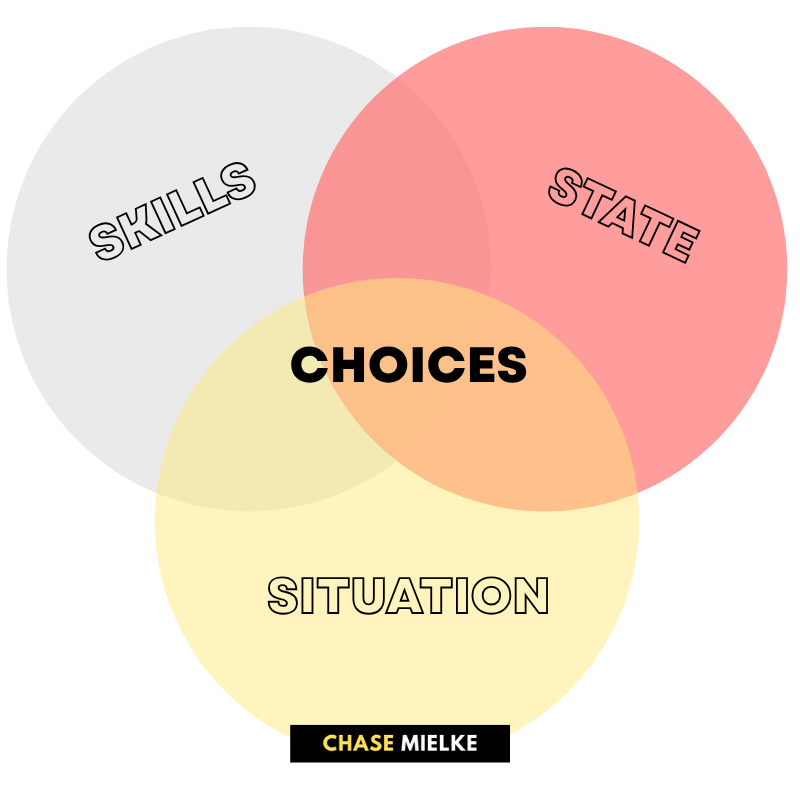
To illustrate, consider emotional hijacking. Neuro-nerds are familiar with the idea that, as activity increases in my amygdala and sympathetic nervous system, activity gets inhibited in my frontal lobe. Every human is susceptible to this and, the more a student already struggles to regulate emotions, the more easily and intensely hijacked their logical systems can be.
To respond appropriately in the throes of emotion, a skill needs to be practiced over and over and over until it is habituated – meaning it can essentially be engaged without conscious thought because rational thought is what gets overridden by emotion (e.g. I’m yelling about my kids yelling even though I know I shouldn’t be yelling).
Challenge the Myth: Accessible skills
Context has to factor into our analysis and support of student behavior. Just because a student has demonstrated the ability to use a skill in the past (e.g. take a calming breath before making a decision) doesn’t mean the kid is choosing not to apply the skill now.
Imagine that, the more a skill requires the use of higher order thinking, the more the skill is on the periphery of our behavioral vision. The stronger we are feeling an emotion, the more our vision narrows (meaning we can’t even see those cerebral behaviors as options). Dr. Bruce Perry’s State Dependent Functioning Model argues that different intensity of emotion along the continuum of calm to terror activates different parts of the brain. On the calm end, more of our frontal lobe is engaged (e.g. logical, rational thinking). On the terror end, more of the “ancient” systems of the brain stem are engaged (e.g. fight, flight, freeze responses). Skill application is state dependent.
Myth #3: Behavior as Free Will
Of all the myths, this is the one that I continue to struggle with the most – despite the overwhelming amount of scientific data, historical examples, and personal experience. Behavioral free will is a myth. I honestly struggled to even type that sentence, so embedded is the idea that every behavioral choice is a free will choice.
Allow me to unpack: We, of course, have moments where we pause, consider options, select an option, then carry out the choice. There is will. However, the myth here is that my will is entirely free of outside influence.
There are more scientific and historical examples than we could name here to illustrate this point. The Stanford Prison Experiment. Virtuous people being complicit in historical genocides. The Milgram Obedience Experiment. Peer pressure. Upgrading my value meal to add that milkshake.
The data is robust: Our choices are just as much – if not more – a product of the situation then our individual skills and decision-making. Yet, we too often put the onus of behavioral change on the character of the individual and ignore the overwhelming power of the context of the incident (Psychologists call this bias the fundamental attribution error).
- The person who cut us off on the freeway is a jerk (even though we cut someone off yesterday when we were distracted by our kids fighting in the back seat).
- That student is lazy because they’re turning in their homework late (even though we submitted our post-evaluation reflection a week after our principal asked for it).
- That kid calling his classmate an asshole is mean (even though his classmate had been intentionally kicking his chair all class long).
The truth is that we all can be inconsiderate jerks on the road – and cautious and prosocial. We can be lazy and we can be productive. We can be mean and kind. Whitman was right: We contain multitudes.
One day, my son got in trouble – not for the first time – for grabbing another kid’s arm at school during indoor recess. We’ve had what feels like 642 conversations and debriefs about how to respect peoples’ spaces and how to calm down when you’re feeling worked up. Deflated and exasperated, I thought, Is my kid just mean!? Does he simply not care about other peoples’ feelings!? Fundamental attribution error.
I found out that the other kid was intentionally trying to destroy the fort my son built during recess. After repeated efforts to tell the kid to stop (Use your words!) my son grabbed the kid’s hand to prevent him from knocking down the fort. He wasn’t instigating. He was defending.
I’m not naive that my son is just as capable of instigating conflict as retaliating conflict. He’s both. As is every kid and every human. The situations influence which version of ourselves – which skills, choices, and values – we express in the moment.
Challenge the Myth: Analyze the Game State
We can’t just focus on individual skills if we want to shift behaviors. We have to analyze and adjust the situations in which those behaviors emerge. This doesn’t mean excusing behavior – it means understanding that individuals and context intertwine to create behavior. The balance of the scale, however, is often skewed. We spend so much time on individuals: Giving them character lessons, behavior plans, one-on-one sessions. Do we spend as much time analyzing how we can shift the situation? How do we factor in student grouping, the timing of interventions or content, whether we’ve created boundaries (and been overt, clear, and consistent in upholding them)? Do we explore not just the choices and effects but the antecedents and emotional states?
Elite sports teams don’t just analyze the data of player skills – they analyze them in the context of game state. What is happening in this specific type of situation? Imagine how much more informed we would be if we kept even rudimentary data on the context of a behavioral issue. Is this happening at a specific time of day? When specific people are nearby (or not)? After similar types of events?
To analyze game state requires that we reflect before we react. Look and listen before we lecture.
I’m a work in progress with all of these myths. This post is my way of expressing a need for accountability.
I’m still working on parenting the kid in front of me, not my fictionalized version of how he should behave or how a kid this age should behave.
I’m still working on not labeling my child or my students based on their character rather than the context.
I’m still having to force myself to reflect on the game state that led to behaviors – to ask more questions, make less assumptions, and generally wait to process information before reacting.
I’m still having to catch myself from saying (screaming?), “How many times have we talked about…!?”
I’m still a product of a society that has embedded these myths of behavior rather than integrating what research, science, and lived experience shows us.
But, I think back to that meeting with the psychologist so many years ago. It wasn’t a wake, mourning the loss of what I expected as a parent. It was an awakening, making me challenge the myths rooted in my expectations. The process I’m learning to habituate is:
- Choosing to wait to address behavior when my kids and I are in a better place to think and talk;
- Challenging the myth about behavior that my brain drifts toward;
- Changing the conversation to focus on the context, the emotional states, and the competencies of the kid and situation in front of me.
Parenting continues to knock me on my ass. But, as the saying goes, I can either give up or get up. Getting up is harder. But it’s making me smarter.
If you found this post relatable, intriguing, or just worth sharing your thoughts, drop a comment below. How have these myths affected your life as a person, parent, and/or professional?

 AFFECTIVE LIVING
Leave a comment