Our happiness levels are dropping.
Since the 1970s, there has been a downward trend in general happiness of U.S. adults.

Source: World Happiness Report
At the same time, we have more access to instant hits of dopamine (the often called “feel good neurotransmitter”) than at any point in our history. Feeling down and want a hit of dopamine? Access it virtually anywhere. Convenient substances in the form of fatty, sugary foods or mind tweaking medications (prescribed or otherwise). Bottomless entertainment at the push of a button — video games and shows designed to feed you dopamine hits every few seconds. Easiest of all a built in “dealer” called a smart phone in our pockets, purses, or permanently fixed to our palms.
So we have more source of “feel good” and yet we feel worse. Why?
There are many debate paths we could explore (*Looks around* Have you seen the state of earth and society!?).
But there’s one thing we have to realize: More dopamine is not the key to greater well-being. We keep looking to dopamine kicks to fix our psychological ills, but most of us misunderstand dopamine: What it does, why we need it, and how it shapes our experience.
In this post, I’m going to get dirty and nerdy about the misconceptions I had with dopamine and how new knowledge has shaped my interaction with life — as an educator, a parent, and a person trying to find more happiness and meaning in life.
- The main event of dopamine is not pleasure
The main event of dopamine is to motivate action. Pleasure is just the byproduct.
In 1953, psychologists Peter Milner and James Olds stumbled upon the brain’s reward circuit. By using electrodes to stimulate the septum in the brains of rats, they could give rats a hit of dopamine whenever they chose. Within minutes they could “train” rats to go to a particular corner of a box, simply by giving their brains hits of dopamine. When they gave rats a lever to stimulate their own reward circuit, rats would hit the lever up to 100 times every minute. Rats would abandon their nursing babies, cross electrified floors and skip sex and food just to get hits of dopamine. Without researchers intervening, starving rats would choose the lever – the hits of positive emotion – rather than eat a meal to stay alive. They would choose dopamine to the point of death. Womp womp.
Why does this matter? Because it illustrates a critical point: The purpose of dopamine isn’t to feel good for the sake of feeling good. Dopamine is designed to motivate action. This is why, for example:
- Dopamine is involved in attention systems, telling us what to focus on. ADHD brains, for instance, produce lower baseline dopamine levels. So a minor environmental change creates a bigger dopamine spike in ADHD brains, leading to struggles with controlling attention.
- Dopamine is involved in movement systems. Ever found yourself mindlessly scrolling social media? Dopamine spikes lead to the habituation of movement; conversely, contextual or movement cues lead to craving dopamine. Smokers often find themselves reaching (engaging the motor cortex) for a cigarette during specific times and cues because dopamine is so strongly linked to movement.
Knowing what to pay attention to and how to move were critical to our survival as a species. Dopamine is part of that key.
2. Pleasure and Pain are two sides of the same coin
Pleasure leads to pain
Let’s talk about craving. Dr. Anna Lembke’s Dopamine Nation taught me something significant about the relationship of dopamine to both pleasure and pain. The same systems involved with pleasure (dopamine spikes) are also involved with pain. Pain and pleasure are an opponent process mechanism. Dr. Lembke frames it as a seesaw. To achieve homeostasis, when we push the “pleasure button” our body responds to the spike by balancing with an increase of pain.

What goes up, must come down.
Think about craving. I used to think of craving as simply a desire for more dopamine. But it’s deeper: Craving is a pain state. It’s a deficit of dopamine. We can’t have pleasure without pain. And we can’t have pain without pleasure.
We must realize that, whenever we get the dopamine hit, we’ll get a pain state next.
3. Excessive artificial dopamine may contribute to decrease in happiness and contentment
Overstimulation of dopamine leads to a baseline of pain
I used to scoff at student gripes when they couldn’t access their phones in class. Seriously…it’s a cell phone…why are you treating it like I’m ripping out your kidney when I ask you to put your phone away!? But now the pain/pleasure seesaw makes it clear: They depend on phones as a source of dopamine. Therefore, removing this source of pleasure creates a literal sensation of pain. Students (and adults) are so accustomed to having constant sources of dopamine hits that life without stimulation is a state of psychological pain.
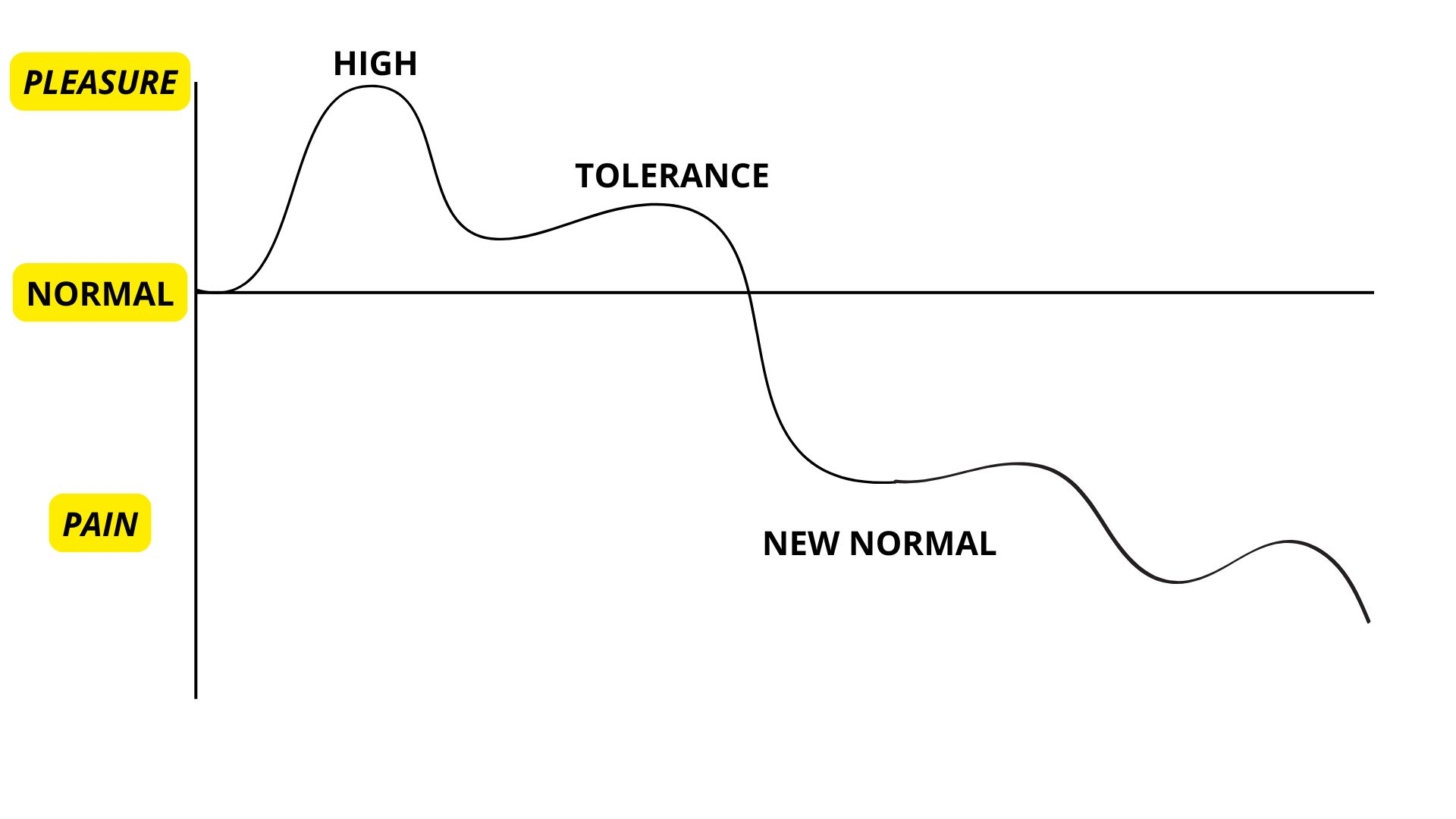
Does this worry you as much as it worries me? The overstimulation of the pleasure side explains, at least in part I think, the paradox of unhappiness. We artificially pump so much dopamine into our lives that the pain/pleasure seesaw is out of whack: We are constantly craving. We are never content.
4. Controlled pain is critical for thriving
Pain leads to pleasure.
How do we get our janky pain/pleasure levels back to a healthy norm? First, we should resist our urges for constant pleasure (Dr. Lembke recommends at least 30 day detoxes from our dope-dealing dependencies). But we can accelerate a healthier re-balance by looking at the other side of the coin: Pushing the pain side can create a higher baseline of pleasure.
Before we punch ourselves in the shinbone, let’s establish that self-induced pain sources should have three conditions:
- A sense of autonomy
- A target goal or end point
- Physical and psychological safety
Exercise is a great example. When you go for a jog, even if you think, “I love running,” your body is like, “No we don’t! What are we running from!?” However, running is healthy because you:
a) have autonomy and control over when you run (versus running from a rabid wolf)
b) have a reason for running and/or an end point for finishing (ending the pain)
c) don’t run to the point of causing literal physical damage (hopefully)
When you run, your body goes into a pain state. To rebalance, you often get hit with endorphins and dopamine following the stress.
Beyond physical exercise, we can apply this in classrooms with problem-solving tasks that require persistence (team-building events, complex puzzles, working out difficult problems). Note that, during a struggle, students (and many adults) will crave a dopamine hit more — so it’s helpful to teach students why this is happening using the Pain/Pleasure Balance model.
5. Educators must become better dopamine dealers
Competing for attention is a must; but it’s not an all-or-nothing war.
When I discuss dopamine in workshops with teachers, I often see them mentally steer toward one of two cognitive cliffs:
- Exasperation (So I have to compete with a dope-dealing iPhone or computer screen fingertips away from my students!?)
- Cynicism (So I have to throw kids candy and prizes just to motivate them to do anything!?)
The answer to first is, Yes. The answer to the second is, No.
The cold reality is that, thanks to smart phones and the monetization of human attention, we do have to compete with more high-dopamine dealing sources than every before. But we can either give up or get up. If our kids come into our classroom with lower reading skills, then we have to adopt new strategies to become better at teaching reading. In the same way, if we care about our content, if we care about our kids, then we have to become better dopamine dealers.
It can feel like we’re in a war, competing for our students’ attention. But focus on the little battles in the classroom because it’s not an all-or-nothing thing. Every little battle we win yields students who learn more than they would have if we had surrendered.
The key is to look proactively, not reactively. Look for a minor tweak to instruction every few minutes, such as:
- A change in your vocal tone or pacing when lecturing;
- Shifting students to do a quick turn-and-talk
- Having students make a quick prediction of what comes next
- Eliciting answers from students
- Doing a quick review question of what was covered
As educators, we’ve always competed with other factors vying for student attention. Bigger problems require greater skill (and the pain state of putting in effort to learn new skill is good for us, remember?)
Now let’s address that second dilemma: Does being a better dopamine-dealer require a classroom carnival filled with nonstop games, candy, and extrnsic rewards? No. Here’s why:
6. There are healthier sources of dopamine
Educators can use free, natural dopamine sources to fuel motivation
Dopamine isn’t a new chemical. Since before humans were alive, dopamine was helping creatures of all walks (and swims, slithers, and flaps) make decisions. Therefore, there are innately wired mechanisms that trigger dopamine beyond candy bars and Candy Crush video games.
Every teacher I know already has dozens of dopamine-dealing pedagogical strategies in their pockets —most of which don’t involve extrinsic rewards or require stocking our classrooms with toys. These strategies are free to use and can be embedded into any lesson. Here are six natural, healthy, and productive ways to give the brain hits of dopamine in a way that improves learning and builds stronger classroom communities:
Joy – Moments of laughter or pleasant experiences
Look to joke, play games, or have moments of humor more often. In our push to make school more serious, we’ve driven students to find more external sources of dopamine. Read: Rigor without joy kills motivation.
Anticipation – Making a prediction or looking forward to something
Have traditions that students look forward to (even minor ones like a “corny joke of the day”). Also, look to embed more predictions into the classroom. Have students predict an acronym before revealing it or guess what happens next in a story, a lab, or a forgotten historical event.
Affirmation – Feeling seen, acknowledged, complimented, and/or accepted by a community
Thank your kids for showing up. Use sticky notes to write quick affirmations. Have students write each other “shout outs” or thank you notes. Adolescents are particularly driven to find affirmation (social media companies thrive off this). Create a classroom culture where affirmation is abounding.
Novelty – Experiencing a safe change or unexpected moment
Create small changes like new attention getting signals. Shift your vocal tone. Change where you stand when teaching a lesson. Switch cognitive processes — like going from discussion to reading to reviewing to predicting. Variety is the spice of attention.
Success – Feeling a sense of completion, victory, or accomplishment
Prompt students to reflect on their “win of the day.” Praise effort, not just results. Have students check off the steps of a process or sequencing of a lesson so they see growth happening.
Social Connection – Experiencing any of the above in the presence of others
Consider social connection the multiplier of the other dopamine sources. Safe, cohesive groups and relationships intensify these dopamine kicks (which is why, for example, watching a comedy movie alone doesn’t make us laugh as hard). Helping students work together and establishing safety, support, and belonging will enhance the positive culture of a classroom.
I could write a whole post diving deeper into these six alone (comment below if you’d like to read that!). But I’ll end by saying this: Each week, try to be 5% better at providing these dopamine kicks in your classroom. Start with what you already do well, just do it a bit more.
———
More dopamine is not the solution to greater happiness and well-being. Sure, it makes us feel good. But in our societal pursuit of stronger, faster, more available dopamine kicks, we’re creating baselines of pain, displeasure, and craving.
As educators and parents we find ourselves thrust into this culture of craving. Frustrating as it might be, we have the influence to help students and kids build healthier baselines — through teaching them the Pain/Pleasure Balance, coaching them through challenges that aren’t always fun, and providing healthier sources of dopamine than they can get from a screen.
And I think that’s pretty dope.*
*Dopamine inducing dad joke, free of charge
 AFFECTIVE LIVING
Leave a comment